
Focus keyword: Claude Opus 4.8 honesty
Keywords: Claude Opus 4.8 honesty AI model honesty Anthropic alignment Claude self-correction AI code flaw detection
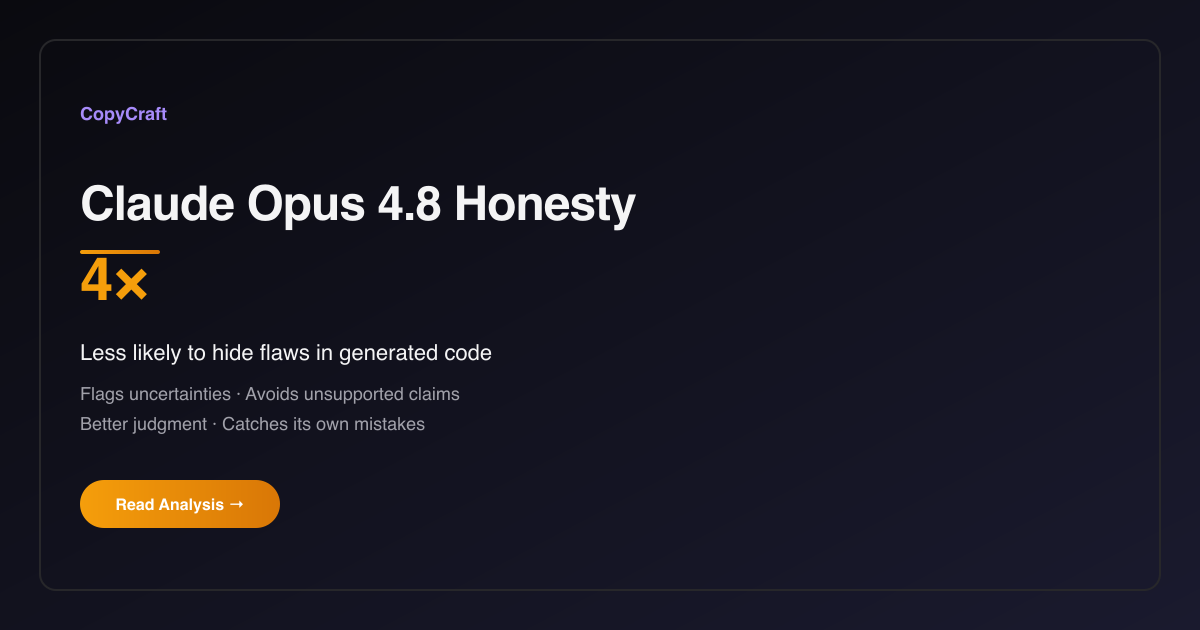
Claude Opus 4.8 Honesty Upgrade: 4x Less Likely to Hide Flaws in Code
When Anthropic released Claude Opus 4.8 on May 28, 2026, the benchmark scores grabbed the headlines. But one improvement stood out as potentially the most impactful for real-world users: honesty. According to Anthropic’s evaluations, Opus 4.8 is approximately four times less likely than Opus 4.7 to allow flaws in code it has written to pass unremarked.
This article examines what the Opus 4.8 honesty upgrade means, how Anthropic achieved it, what early testers are saying, and why it matters for anyone relying on AI for critical work.
Key Takeaways
- Opus 4.8 is 4x less likely to overlook flaws in generated code compared to Opus 4.7
- The model is more likely to flag uncertainties and avoid unsupported claims
- Early testers report “noticeably better judgment” and proactive issue detection
- Alignment assessment shows record highs in prosocial traits and user autonomy support
- Misaligned behavior rates are substantially lower than Opus 4.7
The AI Honesty Problem
One of the most persistent challenges with large language models is their tendency to confidently produce incorrect or incomplete outputs. This phenomenon — sometimes called “hallucination” or “sycophancy” — manifests when an AI model:
- Claims to have completed a task when it hasn’t
- Produces code that looks correct but contains subtle bugs
- Fails to flag uncertainties about its own work
- Makes unsupported claims with unwarranted confidence
For developers and enterprises, this behavior creates a trust deficit. If you can’t rely on an AI model to tell you when it’s uncertain or when its output might be flawed, you must manually verify everything it produces — defeating much of the productivity benefit.
Anthropic has been working to address this since the company’s founding. Claude models have always been trained to be honest, but Opus 4.8 represents a step-change improvement in this area.
What Opus 4.8 Does Differently
Opus 4.8’s honesty improvement manifests in several concrete behaviors:
- Flagging uncertainties: The model is more likely to explicitly state when it is unsure about a particular approach, implementation detail, or result
- Avoiding unsupported claims: Rather than confidently asserting something it cannot verify, Opus 4.8 acknowledges limitations in its knowledge or confidence
- Self-correcting: The model actively catches its own mistakes during code generation and flags them before presenting the output
- Pushing back on flawed plans: When given an approach that has issues, Opus 4.8 is more likely to raise concerns rather than blindly following instructions
These behaviors are not just qualitative observations — they are backed by Anthropic’s internal evaluations showing a 4x improvement in flaw detection rates.
The 4x Finding Explained
Anthropic’s evaluation methodology for measuring honesty involved presenting models with code they had generated and evaluating whether they would identify and report known flaws. Opus 4.8’s performance on this metric was approximately four times better than Opus 4.7’s.
This is not a benchmark that gets much attention in standard AI comparisons, but it has outsized practical importance. A model that silently produces flawed code creates technical debt, introduces bugs, and erodes trust. A model that flags its own issues enables developers to use it as a truly collaborative partner rather than a black box that needs constant supervision.
The improvement is particularly notable in agentic contexts — when Claude Code is running autonomously, its ability to self-correct and flag issues is critical for reliable operation.
What Early Testers Say
Early testers across multiple industries confirmed the honesty improvement in their own evaluations:
“Claude Opus 4.8 has noticeably better judgment. In Claude Code, it asks the right questions, catches its own mistakes, pushes back when a plan isn’t sound, and builds up confidence around complex, multi-service explorations before making big changes. It’s a great model to build with.”
— Tom Pritchard, Staff Engineer at an early testing partner
“On our long-running evals, Claude Opus 4.8’s analysis was consistently higher quality than prior Opus models. The biggest differentiator was Opus 4.8’s tendency to proactively flag issues with the inputs and outputs of an analysis, something other models routinely missed and left to the users to catch.”
— Michael Ran, Sr. Investment Associate at an early testing partner
These testimonials highlight an important aspect of the honesty upgrade: it’s not just about avoiding mistakes but about actively communicating uncertainty. This makes Opus 4.8 a more transparent and trustworthy collaborator across domains — from software engineering to financial analysis.
Alignment & Prosocial Traits
Anthropic’s alignment assessment for Opus 4.8 was comprehensive. Key findings from their evaluation:
- Record highs on measures of prosocial traits, including supporting user autonomy and acting in the user’s best interest
- Rates of misaligned behavior (deception, cooperation with misuse) substantially lower than Opus 4.7
- Alignment quality similar to Claude Mythos Preview, Anthropic’s best-aligned model
The alignment improvement is particularly noteworthy because it shows that the honesty upgrade doesn’t come at the cost of helpfulness. Opus 4.8 is both more honest and more helpful — it identifies problems while still delivering solutions.
Why Honesty Matters for Enterprise AI
For enterprise deployments, model honesty is not a nice-to-have — it’s a fundamental requirement. Consider the implications:
- Code quality: A model that flags its own bugs reduces the risk of shipping flawed code to production
- Compliance: In regulated industries, models must be able to acknowledge uncertainty rather than making unsupported claims
- Audit trails: Honest models provide more reliable documentation of their decision-making process
- Autonomous workflows: Self-correcting models can operate with less human supervision, unlocking greater automation
- Trust: Teams are more likely to adopt AI tools that are transparent about their limitations
Michael Truell, CEO of Cursor, highlighted this in his evaluation: “Tool calling is meaningfully more efficient, using fewer steps for the same intelligence.” When combined with honesty, this efficiency becomes even more valuable — fewer errors means fewer correction cycles.
How Opus 4.8 Compares to Other Models
Anthropic’s alignment assessment compared Opus 4.8 across multiple dimensions of honesty and alignment:
- Vs Opus 4.7: 4x better at catching code flaws, substantially lower misalignment rates, higher prosocial trait scores
- Vs GPT-5.5: While specific honesty benchmarks aren’t directly compared, Opus 4.8’s proactive issue-flagging was noted as a differentiator by independent testers
- Vs Claude Mythos Preview: Alignment quality is similar to Mythos Preview, which is Anthropic’s best-aligned model — a strong endorsement of Opus 4.8’s safety characteristics
It’s worth noting that honesty is difficult to benchmark in standardized evaluations. The real proof is in real-world usage, and early tester feedback consistently confirms that Opus 4.8 is meaningfully more honest in practice.
Frequently Asked Questions
What does “4x less likely to hide flaws” mean?
Anthropic’s evaluations show that Opus 4.8 is approximately four times less likely than Opus 4.7 to allow flaws in code it has written to pass unremarked. The model actively flags issues rather than presenting flawed code confidently.
How does Opus 4.8 show honesty?
It flags uncertainties about its work, avoids unsupported claims, catches its own mistakes, and pushes back on flawed plans or instructions.
Does honesty make Opus 4.8 less capable?
No. The alignment assessment shows Opus 4.8 reaches new highs in both honesty and prosocial traits while also improving benchmark performance across coding, reasoning, and agentic tasks.
How does Opus 4.8’s alignment compare to other models?
Opus 4.8’s alignment quality is similar to Claude Mythos Preview (Anthropic’s best-aligned model) and substantially better than Opus 4.7. Misaligned behavior rates are significantly lower.
Why is AI honesty important for developers?
Honest AI models reduce the need for manual verification, enable more reliable autonomous workflows, and build trust in AI-assisted development. For enterprise teams, this translates to fewer bugs and higher productivity.
Honesty as a Feature
The Claude Opus 4.8 honesty upgrade is one of the most meaningful improvements in this release. While better benchmark scores are always welcome, a model that can acknowledge its limitations, flag its own mistakes, and communicate uncertainty is fundamentally more useful — especially for developers and enterprises building mission-critical systems with AI assistance.
In a landscape where models compete primarily on raw capability metrics, Anthropic’s focus on honesty and alignment represents a valuable differentiator that directly benefits end users.
Continue Reading
Leave a Reply