
Focus keyword: Claude Opus 4.8 fast mode pricing
Keywords: Claude Opus 4.8 fast mode pricing Opus 4.8 cost Claude API pricing Anthropic pricing 2026 Claude fast mode speed
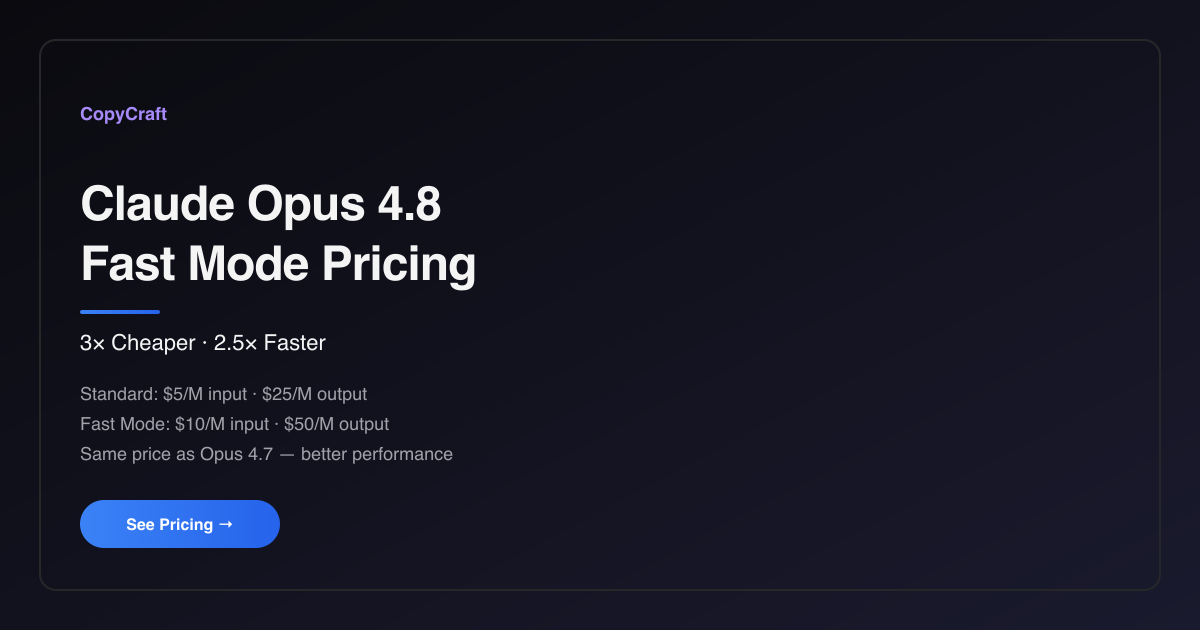
Claude Opus 4.8 Fast Mode Pricing: 3x Cheaper at $10/M Tokens
One of the most welcome announcements in the Claude Opus 4.8 release is the dramatic price drop for fast mode. Previously the premium speed option came at a significant premium, but with Opus 4.8, fast mode is now three times cheaper than it was for previous Opus models — making high-speed AI more accessible than ever.
This article breaks down the complete Claude Opus 4.8 pricing structure, compares standard vs fast mode, explains the cost implications for different use cases, and helps you decide which mode is right for your needs.
Key Takeaways
- Standard pricing unchanged: $5/M input tokens, $25/M output tokens — same as Opus 4.7
- Fast mode 3x cheaper: $10/M input, $50/M output — down significantly from previous Opus models
- Fast mode delivers 2.5x speed over standard mode
- Opus 4.8 at high effort delivers better performance than Opus 4.7 at similar token cost
- Developers use model ID
claude-opus-4-8via the Claude API
Opus 4.8 Pricing Breakdown
Here is the complete pricing for Claude Opus 4.8 across both usage modes:
| Usage Mode | Input Tokens | Output Tokens | Speed |
|---|---|---|---|
| Standard | $5 per million | $25 per million | Baseline |
| Fast Mode | $10 per million | $50 per million | 2.5× faster |
Standard pricing is unchanged from Opus 4.7. This is notable because Opus 4.8 delivers significantly better performance at the same price point — effectively a price-to-performance improvement even before considering the fast mode savings.
Fast Mode: 3x Cheaper Explained
The headline pricing news is that fast mode for Opus 4.8 is three times cheaper than it was for previous Opus models. This is a substantial reduction that changes the economics of using Claude for high-throughput applications.
To put this in perspective: previous Opus fast mode was priced significantly higher — reportedly around $30/M input and $150/M output (3x the standard rate). With Opus 4.8, fast mode is now only 2x the standard rate ($10 vs $5 input, $50 vs $25 output), while delivering 2.5x the speed.
The savings calculation is straightforward:
- Previous fast mode pricing: ~$30/M input, ~$150/M output (3x standard)
- Opus 4.8 fast mode pricing: $10/M input, $50/M output (2x standard)
- Savings: 67% reduction in per-token cost for fast mode
For API users who rely on fast mode for production workloads, this reduction can translate to thousands of dollars in monthly savings depending on usage volume.
Standard vs Fast Mode: When to Use Each
Standard Mode ($5/$25 per M tokens)
Standard mode is the default and best choice for most use cases. It delivers Opus 4.8’s full intelligence and reasoning capability at the most economical price point. Use standard mode for:
- Complex analysis and reasoning tasks
- Code generation and debugging
- Content creation and editing
- Research and data analysis
- Any task where output quality is the top priority
Fast Mode ($10/$50 per M tokens)
Fast mode offers 2.5x speed at 2x the per-token cost. Use fast mode when:
- Latency is critical (real-time applications, chatbots)
- Processing high volumes with moderate complexity
- Batch processing where throughput matters more than per-request cost
- Prototyping and iteration cycles
Importantly, both modes use the same underlying model (Opus 4.8) with the same capabilities. The difference is only in processing speed, not output quality.
How Opus 4.8 Pricing Compares to Opus 4.7
When comparing Opus 4.8 to Opus 4.7, the value proposition is clear:
| Metric | Opus 4.7 | Opus 4.8 | Delta |
|---|---|---|---|
| Standard input price | $5/M tokens | $5/M tokens | Unchanged |
| Standard output price | $25/M tokens | $25/M tokens | Unchanged |
| SWE-Bench Verified | 70.2% | 73.1% | +2.9% |
| TAU-Bench (retail) | 72.5% | 85.8% | +13.3% |
| Fast mode input price | ~$30/M tokens | $10/M tokens | -67% |
The bottom line: Opus 4.8 costs the same or less than Opus 4.7 while delivering more capability. For standard mode users, this is a free performance upgrade. For fast mode users, it’s both a performance upgrade and a significant cost reduction.
Cost Optimization Strategies
To get the most value from Opus 4.8, consider these strategies:
- Default to standard mode for most tasks — it offers the best price-to-performance ratio
- Reserve fast mode for latency-sensitive applications where the 2.5x speed justifies the 2x price
- Use effort control wisely — lower effort levels reduce token consumption. For straightforward tasks, low effort on standard mode is the cheapest option
- Batch non-urgent requests during standard mode to avoid paying the fast mode premium
- Monitor token usage by effort level to identify opportunities for cost optimization
Enterprise & Plan Pricing
Beyond per-token API pricing, Claude Opus 4.8 is available through several plan tiers:
- Claude Max plan — includes access to Opus 4.8 with higher rate limits
- Claude Team plan — collaborative access for teams
- Claude Enterprise plan — dedicated infrastructure, SSO, and enterprise-grade support
- Claude API — pay-as-you-go via
claude-opus-4-8model ID
Enterprise customers may negotiate custom pricing for high-volume usage. The API pricing serves as the baseline for most developers and businesses.
Frequently Asked Questions
How much does Claude Opus 4.8 cost?
Standard mode: $5 per million input tokens, $25 per million output tokens. Fast mode: $10 per million input tokens, $50 per million output tokens. Standard pricing is unchanged from Opus 4.7.
Is fast mode 3x cheaper now?
Yes. Fast mode for Opus 4.8 is three times cheaper than it was for previous Opus models — a 67% reduction from the prior ~$30/$150 per M tokens pricing.
How fast is fast mode?
Fast mode delivers approximately 2.5x the speed of standard mode, making it suitable for latency-sensitive applications.
Does fast mode affect output quality?
No. Fast mode uses the same Opus 4.8 model — the only difference is inference speed. Output quality is identical between standard and fast mode.
Is Opus 4.8 more expensive than Opus 4.7?
No. Standard pricing is identical. Fast mode is significantly cheaper. Combined with better performance at the same token count, Opus 4.8 offers better value than Opus 4.7.
How do I access Opus 4.8 via the API?
Use the model ID claude-opus-4-8 in your API calls. It is available through the Claude API platform at standard and fast mode pricing tiers.
Better Performance, Lower Costs
Claude Opus 4.8 delivers on the rare promise of more capability at lower cost. With unchanged standard pricing, dramatically cheaper fast mode, and across-the-board benchmark improvements, it represents one of the best value propositions in the current AI landscape.
For developers, enterprises, and API users, the math is simple: Opus 4.8 costs the same or less than Opus 4.7 while delivering more intelligence per token.
Leave a Reply